
Hack the Hub: What Happens When You Invite People to Build With You
A two-week work residency in Austria, a task board, and a question worth asking: what if more hubs tried this?

I went to Commons Hub Austria two weeks before Easter 2026, when the space was quiet and the to-do list was long. I went as part of the Hubs Network team, three of us, with the intention of observing how a residency like this actually runs when it runs well. I ended up also building garden beds, collecting rocks, hanging things, shooting video, and having some of the best conversations I have had in a long time.
That is roughly how Hack the Hub works.
What It Is
Commons Hub Austria sits an hour from Vienna. Felix and Dan, the co-stewards, run the place year-round. Like most hubs, there is always more to do than there are hands to do it. Gardens, infrastructure, building projects, maintenance. The kind of work that never quite gets finished.
Hack the Hub is their answer to that. You come and stay for up to two weeks. You work four hours a day on whatever the space needs. In exchange: accommodation and food, covered. That is the whole deal.
This was their second time running it. At peak, twenty-five people were on site.


Who Showed Up
Most people who came already had some connection to Commons Hub, either they had visited once, spent time there before, or were active in their online community. One person found the residency posted on Facebook and just came. That felt important to me. The door was genuinely open.
The mix of skills was wide. Architects, builders, therapists, technical people, people with blockchain backgrounds, people who just wanted to do something with their hands for a while. What everyone had in common was harder to name but easy to feel: a shared orientation toward doing things together, building things, making spaces more liveable and more beautiful.
How the Days Ran
Wake up around 7 or 8. Breakfast was organized, food was provided, no structure imposed on the morning. At 9am the group gathered. The task board had everything listed. People looked at the board, looked at each other, and grouped themselves according to what they wanted to do and what they knew how to do.
Some work was outside, some inside. The first week brought snow and rain, which closed down most of the outdoor tasks. Nobody panicked. The group just shifted. Mattresses got swapped for more comfortable ones. Curtains went up. The entrance got a makeover and a shoe rack. The workshop got a real layout for the tools. The indoor list, it turned out, was just as full as the outdoor one.


When the weather cleared, the outdoor work started. Garden beds were built. Rocks were collected and laid. A sauna was assembled. A hot tub installation was finished. The space was documented on video.
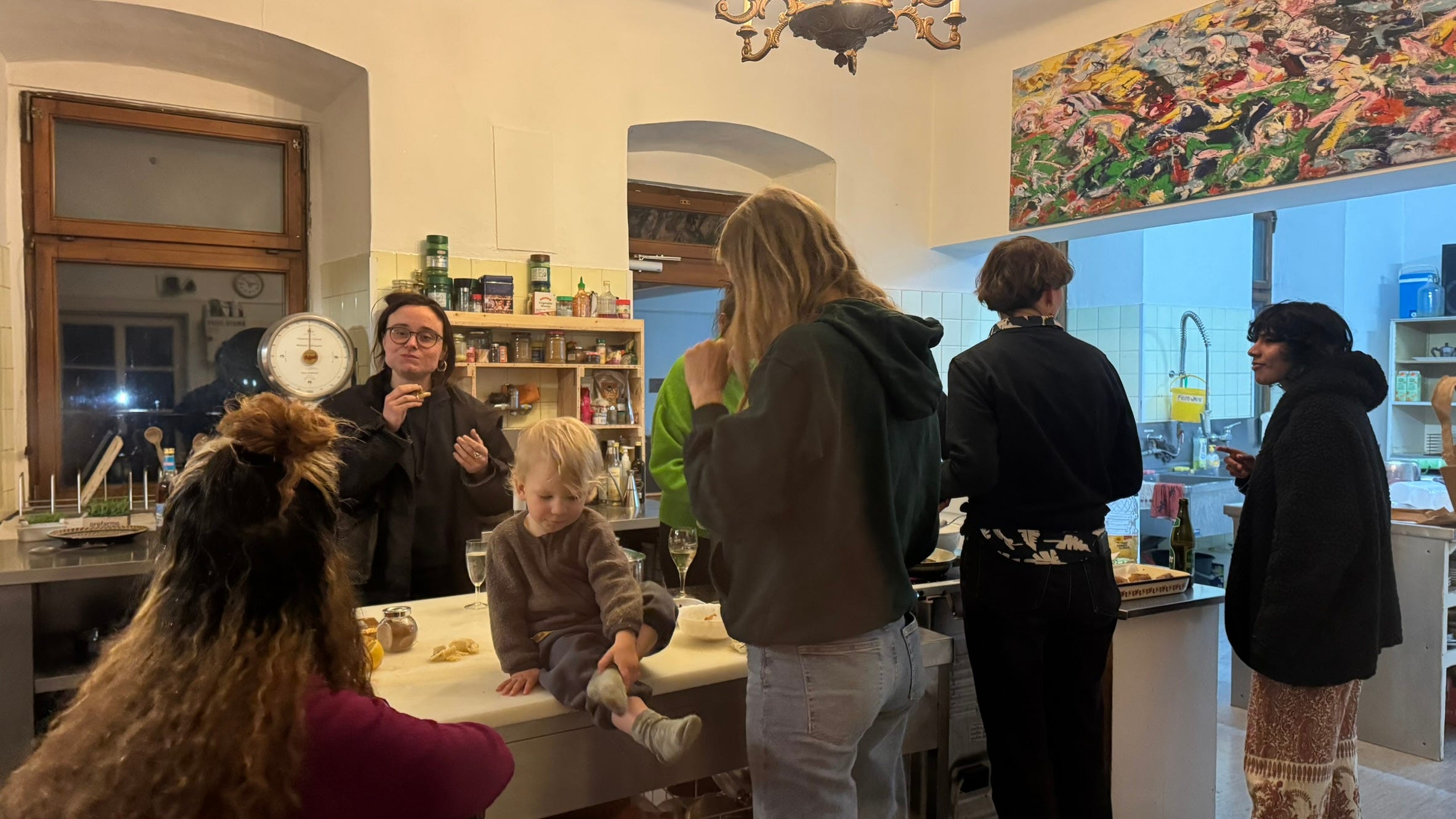
Lunch was communal. Participants took turns cooking. Others cleaned up. There was a rhythm to it that settled in by the second or third day without anyone having to design it.
Afternoons had more work, two or three hours depending on the day and the energy. Evenings were loose. Walks, games, fire. Both weekends had a party. One had a pizza night with music. People played guitar, shared things, performed. The creative life and the work life were not separate. It was the same group, in the same space, doing different things on different days.
What It Was Worth
As part of this case study, we looked at what the work produced in market-rate terms. Not because that is the right frame for what happened, but because it makes the model legible to anyone trying to decide whether it is worth running. And to understand what a sharing economy means.
Assembling a wood prefab electric sauna in the Vienna area, including foundations and electrical hookup, costs between €6,000 and €10,000 or more in just in work hours. A 40m² workshop fit-out lands between €3,500 and €9,000. A custom built-in shoe rack, around 10 to 12 man-hours of carpentry, is €600 to €900. A hot tub upgrade runs €1,000 to €1,500. A private chef cooking for 10 people every day for two weeks would cost €7,000 to €11,200 in service fees, before groceries.
Even if we take the lower end rates sums up to €18,100 (for the high end: €32,600)
On the other side, the hub provided accommodation worth roughly €55 per person per night, and food at estimate of €12 per person per day. That is a real cost. So on average of 10 people for the full 2 weeks this cost would be around €9,380.

And then there are the things that do not appear on any invoice. Interior design input. Video documentation. Professional DJ sets. exquisite bartenders. The specific knowledge people brought and left behind. The conversations by the fire. The friendships made while preparing food together. And feeling at home by building and care for the environment that you share.
Those have no market price. They are also the reason people come back.
What Working as a Team There Felt Like
I want to say something about what it was like to be there as a team of three from Hubs Network, not just as individuals but as colleagues living and working in the same physical space for two weeks.
It changed how we worked together. Side conversations happened naturally over lunch. Decisions that would normally take a thread of messages got made quickly because we were already in the room. There was a shared context that built up over days, the kind that is hard to replicate on a call or in a document.
I think we underestimate how much distributed organizations lose by never being in the same place. The residency gave us that, almost accidentally, alongside the instant gratification of supporting the Commons Hub on this physical level. Feedback loops of what value we can bring to Hubs, were immediate. This is in contrast to other more digital infrastructures we are building together.
What Did Not Run Perfectly
The cleanliness standards were inconsistent. Some participants, particularly those less familiar with the space, had different thresholds for what counted as tidy. Some came from a culture where a certain organized chaos is the norm. These tensions were small but real, and they got resolved through conversation rather than rules, which worked, but took energy from the stewards.
Newcomers without prior community context sometimes needed more orientation than a organized format naturally provides. The model works most efficiently when people arrive already carrying a commons mindset. But then again, one of the main visions of the Commons hub is to open minds to this new ways of living together and sharing goods.
The Problem That a Network Can Actually Solve
Felix named the real bottleneck clearly: finding people you can trust.
A residency like this means handing over real access. To the kitchen, the tools, the physical space, the fabric of the stewards’ working life. Vetting strangers for that kind of access is slow and uncertain, especially when you are already running the place on a lean operation.
This is where a network of hubs has structural value that no individual hub can create alone. If someone did a residency at another hub and the stewards there can vouch for them, that changes everything. Trust becomes transferable. The friction of finding good participants drops. You are not starting from zero every time.
It is one of the clearest practical cases for what Hubs Network exists to do.

Why I Think More Hubs Should Try This
Most hubs have maintenance backlogs. Most hubs have project ideas sitting on a shelf for lack of hands. Most hubs also have communities of people who want to contribute to something real, do physical work, and spend time in good company outside of their usual context.
The Hack the Hub format has a balance between creating enough structure for the group to self-organize and then let it flow. The hard part is trust and sourcing. The rest is mostly logistics.
The result is people building the space together, so they feel home and start caring for a place like you can only do if you feel part of it. And they will come back for events or other activities and then are not just attending, they are sharing not only the space, but also the host role.
Commons Hub Austria has now run Hack The Hub twice. It works. What I came away with is a conviction that this is replicable, and that building an infrastructure for residencies just like this, is definitely worth doing.